

When Is an Agent Not An Agent?
All the innovation is in AI Agent Design Patterns

Everything in tech today is about AI Agents. So much so that the meaning of “agent” and “agentic” have almost lost all meaning as companies race to slap them on anything and everything.
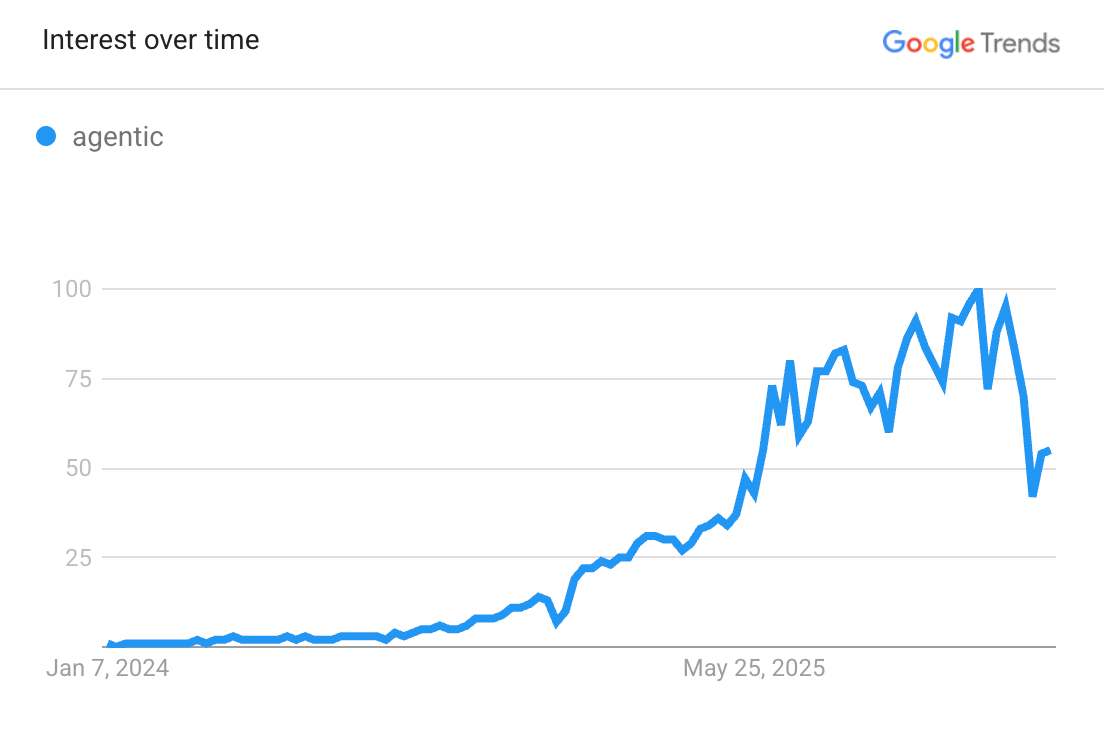
While there is not a consistent definition, the implication is that an agent can perform multi-step tasks that would otherwise require a human. There are some great agents in the market today, such as Claude Code which can build a fully functional, complex application from a detailed description. Similarly, the Deep Research functions of Gemini and ChatGPT can research a topic online and provide a full report to you. These agents can take minutes or hours to complete their tasks and deal well with ambiguity.
Those agents are fairly complex, but many agents follow some simpler, standard patterns. These patterns are less complex but also less powerful, and raise the question of whether the products built using them are truly “agentic”. We’ll walk through them and try to answer the question of whether they are truly agents.
The most common of these patterns are:
Decision Trees
Criteria Loops
Planners
Agent Type 1: Decision Trees
Decision trees are an old computer science design pattern where decisions are broken down into branching steps. There is some kind of input, and a structured flow of decisions to be made from the input that lead to a set of potential next steps. In the case of agents, the nodes in these decision trees are LLMs with prompts that produce the decision.
For example, let’s say we want to process tax documents for an accounting firm. The input might be a PDF document, which the user uploads. The first step of the decision tree is to determine what kind of document it is (W-4, 1099, etc.). Based on the document type, it would be routed to another step that might extract the relevant fields from that document using an LLM. Depending on what those values are, it is then routed to another step to decide how it affects their taxes. And so on.
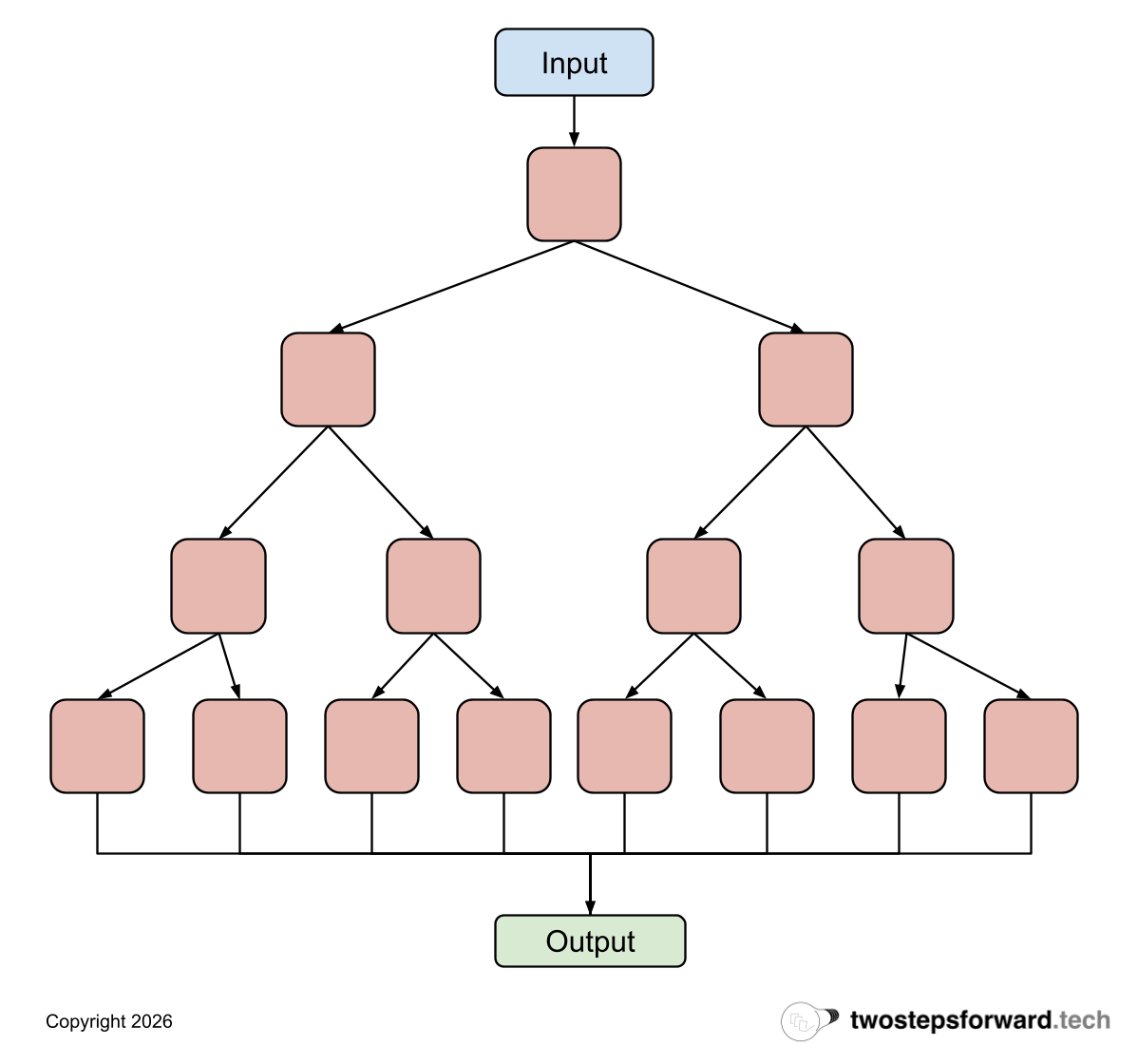
Decision trees are powerful, even without LLMs. They can take complicated decision processes and codify them for automation, which LLMs make even more powerful. Even better, by breaking down the decision process into small, atomic pieces it reduces the potential hallucinations of LLMs and improves the accuracy and fidelity. LLM-based decision trees really can feel like magic.
However, a decision tree is a structure that does not change. Every document would go through the same decision tree in our example above, until the code is changed to change the tree. There is no real structured thinking except for the decision at each node in the tree. There is no learning or improvement based on experience or memory.
As a result, decision trees will struggle to handle anything that doesn’t fit the rigid expected range of inputs and states. If you upload a document that the decision tree wasn’t designed to handle, it won’t be able to do anything.
Because of this static structure, I think it’s hard to classify them as true agents. Yes, they feel like they are doing human-level work when they work. But the inability to work outside of very structured processes means that they cannot deal with ambiguity and as a result are more like very intelligent deterministic processes.
Verdict: Not Agents
Agent Type 2: Criteria Loops
Loops are very simple structures, where a program is told to repeat until certain criteria are met. With LLMs this means working on a task until a pre-defined set of criteria is achieved by the output.
For example, if we want to search the web for specific information about a business we can ask an LLM to perform the task. It might find it on the first try, but it might not! The loop would require a specific criteria on the answer such as a website, an address and a phone number. The LLM would run, find what it can and compare to the criteria. If it doesn’t match, it goes back and keeps searching.

These loops can handle much more ambiguous problems than decision trees because the actual steps and decisions are not hard-coded. The LLM can do whatever it thinks is necessary to achieve the goal, while the criteria ensure that we get a desired result.
The challenge is that these loops can go on forever. Imagine we ask the system to find a company that doesn’t exist, it could keep searching forever and never meet the criteria! There is usually a limit put on the number of iterations the loop can perform but that means in some cases no result matching the criteria will be produced.
Similarly, the result is only as good as the criteria. On complex problems this can be difficult because it might not be possible to describe the result if you aren’t quite sure what it needs to be. In those cases you can have other LLMs act as the critics, evaluating the results against some vague criteria and using some judgement on whether to continue. That is recursive as well!
Loops are powerful as long as they don’t get stuck, and have enough iterations to find the goal. While not as good at humans at every task, criteria loops are definitely agents.
Verdict: Agents
Agent Type 3: Planners
Planners are a design pattern used for the most complex tasks. In this design, there are two steps:
Planning. The system creates a plan on how to achieve the required outcome.
Execution. The system executes each step of the plan, updating the plan along the way.
As a result, these systems are really two systems in one. The Planner needs to be good at building a plan and the criteria to know if it was successfully performed. Then an Executor needs to execute the plan in a way that meets the criteria.
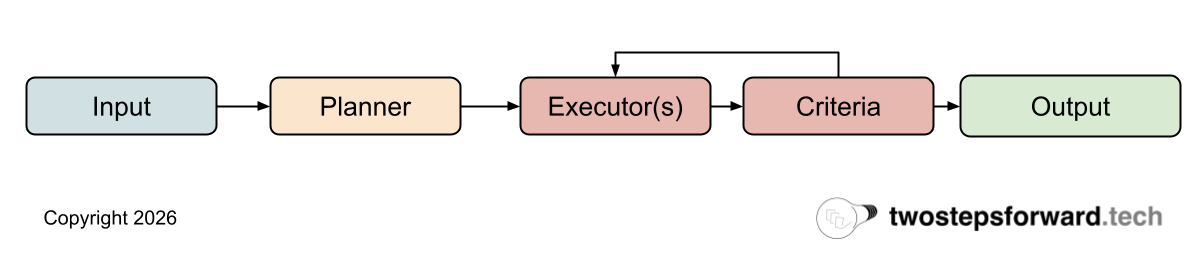
In some cases the Planner is a decision tree, and in others it’s a Criteria Loop. The Executors are almost always Criteria Loops as they need to continue until the step of the plan they are working on is completed.
These systems often take a long time to run, since generating the plan takes time and then executing every step the plan takes time. In most cases the steps are executed serially, which takes even longer. However, for complex tasks it’s worth the time as it greatly improves the chances of achieving the desired outcome.
Since this pattern underlines most of the high quality agents you might use, these are the current standard of agents.
Verdict: Definitely Agents
The Bottom Line
These are just a few different design patterns for agents, there are many more. In fact, agent design is one of the most interesting areas of AI right now!
OpenClaw has become a hot product but it includes no innovation on the LLM/AI side at all. It’s just a good collection of design and implementation of a variety of different agent design patterns. The same is true of Claude Code which is just a set of agent design patterns on top of the Anthropic LLM you can use directly. These design patterns turn the existing AI into something new and more powerful.
In the coming months and years we’ll see a lot of interesting new ideas arise in agent design patterns. It’s also likely that a virtuous cycle will erupt where agent design patterns provide ideas around better training of LLMs and vice versa. That kind of cycle creates even faster innovation and improvements.
As a result, expect agents to get a lot more interesting in the near future.