

The Thousands of Islands of AI
How do you find a product in an infinite pile of products?

Today, a single person can use AI codegen tools to build a handful of products everyday. They can spin up dozens of agents who write code faster than any human, test it and deploy it while watching a movie. The sheer number of software products being built now each week dwarfs the output of the entire software industry for months just a few years ago.
At the same time, it’s harder than ever to find any of these new products. In a world awash with software, how do you discover something new? The biggest risk to products in this new world is that no one ever knows about them.
AI is allowing us to build thousands of islands that no one can find.
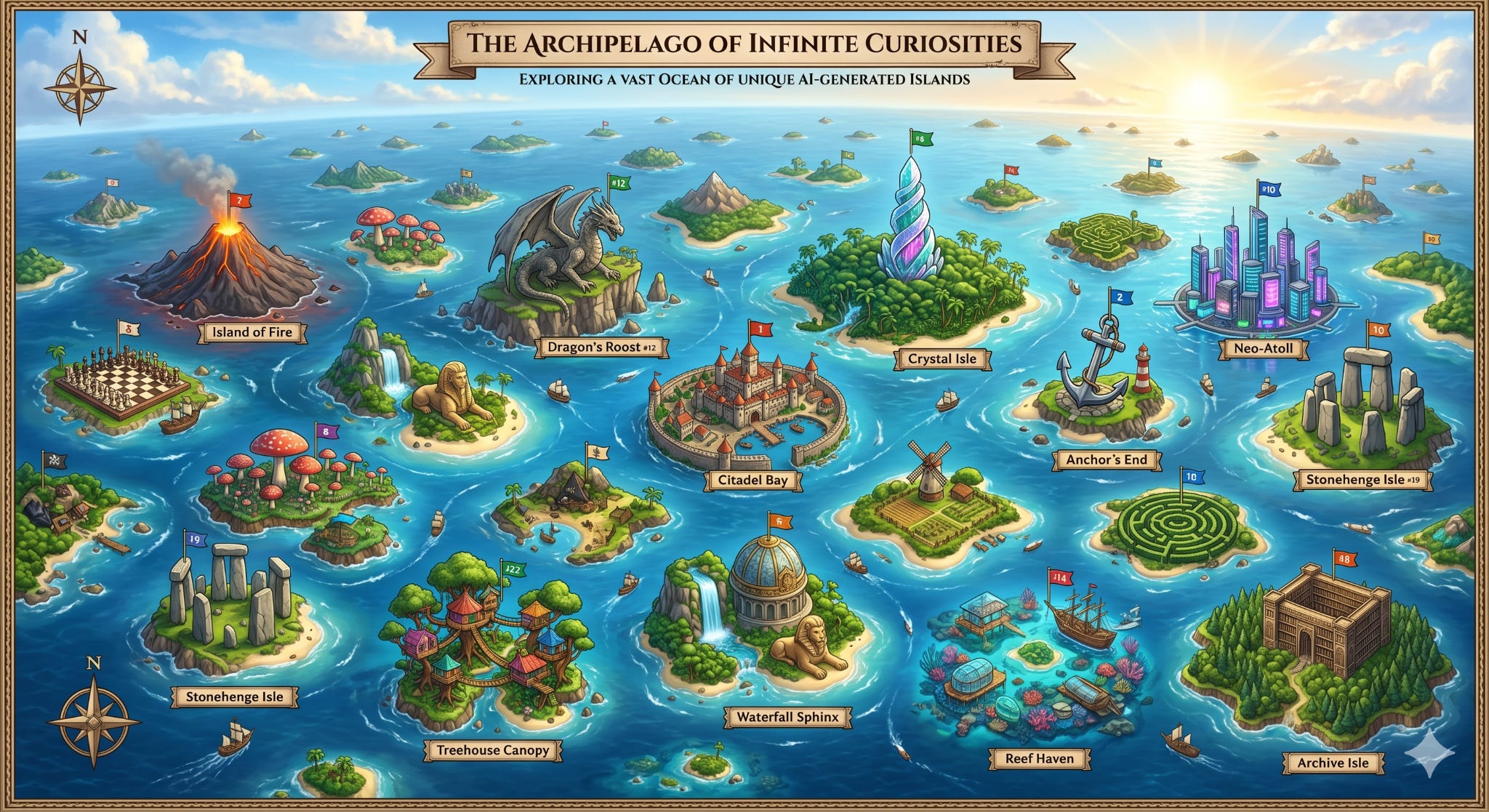
Discovery is the Only Problem
Anyone who has ever built a product will tell you that the hardest problem is discovery. If your customers don’t know you exist, they can’t use/buy your product!
Large companies have marketing budgets and spend money on ads, PR, events and sponsorships to get the attention of customers. Google has built one of the largest businesses in human history simply by helping connect companies with potential customers for a fee.
Smaller companies don’t have that luxury, so they try to reach customers through referrals, network effects and partnerships. Channel partners exist to bring products to new customers, again for a fee.
In all cases, figuring how to reach the customer is the hardest part. Even when writing software was hard, reaching the customer was harder. That is still true now.
It is so hard that if you have an audience of customers you have a competitive advantage in any market. Mr Beast continues to roll out new products and make a lot of money, but not because his products are better. It’s because he has a captive audience to sell these products. He has the discovery problem solved, and creating products to be discovered is the easy part.
Most of us lack a captive audience to expose our AI built products to, so what are we to do? How do we compete with the thousands of products being built everyday for the attention of potential customers? How do we stand out?
An Audience of One
In many cases, this might not be a problem. Many people building apps with AI are building for themselves, an audience of one. Maybe it’s a new productivity tool, or a different way to manage your calendar. Maybe it automates a very specific part of a specific job that no one else needs.
I did this myself, building a new kind of list manager called Windmill that helps you manage dozens and dozens of lists. Everything from todo lists to grocery lists to packing lists and you can promote items from various lists to your “Todo Today” or “Todo Tomorrow” lists. I know, that’s a very specific way of working but it’s my way. I never found a product that let me manage my lists the way I wanted, and now I have exactly what I need.
For these kinds of “solo apps”, discovery isn’t a goal so it’s not a problem. I’m happy using Windmill myself, and if anyone else ever finds value in it then that’s just a bonus. Many of the apps being created fall into this category.
But what about the ones who want a larger audience?
Discovery in the Age of AI
We’ve been here before. I’m old enough to remember that before Google, there was no good way to find websites on the early internet. The old search engines were useless, directories were overflowing and you were forced to rely on friends referring you to new sites.
Google solved this problem by looking at how websites were linked together. These new AI products have no links, they are entirely disconnected from each other and the world.
Apple solved discovery by controlling the AppStore and making it a central point of discovery. Even then, it’s hard to find apps in the AppStore as there is so little information to search on (name, description, etc). There is no central discovery point for AI.
We need a new approach for AI. Perhaps the hosting platforms will begin indexing the apps deployed on their platforms, so it gets easier to find something hosted on Lovable or Replit.
Or perhaps we’ll have something like MCP, a protocol that apps can use to publish their capabilities for others to discover more easily.
Or maybe we’ll never find a good solution, and the answer lies in unique and novel marketing strategies. Facebook Ads, when it first came out, powered a lot of mobile app distribution at a time when the AppStore didn’t really have search working yet. We might see something similar again.
The Bottom Line
The good news about distribution is that it’s a problem that solves itself. Distribution is so critical to the success of any product that it becomes the focus of all the best builders. Eventually someone figures it out, and then everyone copies what works.
We haven’t seen the first great vibe coded app breakout success yet, but I suspect we’re not far away. When it happens, you can believe everyone else will be taking notes and a new form of app distribution will be born.